
Before I bought my BalanceFrom mat I was doing floor stretches on a folding camping blanket over the tile in my Mesa garage, and I have the spine to tell you my knees filed a formal complaint. The tile was unforgiving. Any time I tried to work on my back, which has been in various stages of grumpy since a lower-back episode four years ago, I would load my hips or wrists or knees and give up within a few minutes. Ten minutes of gentle movement felt like a small punishment.
So when I kept seeing an extra thick mat with a thousand nearly full score reviews, I assumed I was getting the answer to the tile problem. The BalanceFrom mat is one inch thick and dense, and the reviews were right about the cushioning. They were also, I learned over a year of daily floor work, almost completely silent about the thing that almost made me send it back. Here is the honest version, the one the four-and-a-half-star wall does not mention.
The Quick Verdict
Superb cushioning for knees, hips and wrists, and a real stability tradeoff in standing poses. Buy it for floor work. Do not expect it to behave like a thin mat under your feet.
Amazon Check Today's Price →The mat that finally got me off the tile
If your current setup is a towel on a hard floor, this is the mat that makes stretching feel like an option again. Check today's price and the current color options before you decide.
Amazon Check Today's Price on Amazon →How I've Used It
I have owned this mat for about fourteen months. It lives in my garage next to the squat stand, latitude around thirty-three north, so it has endured a full Arizona summer in a space that is not air conditioned and a shockingly cold desert winter. I use it almost every day, usually twice. Mornings are for the lower-back stretches and a little core work. Evenings, after I close up my little shop, I use it for hips and the floor routine I put together after physiotherapy.
My setup is unglamorous. The mat goes out flat on the concrete, I pull my knees up, and I do the same twenty-minute routine the physio handed me, the one that kept me out of surgery and, more importantly, kept me training. I am fifty-eight, I weigh about a hundred and sixty, and I have no interest in pretending I am twenty-five. What I want from a mat is simple, I want the ground to stop hurting me so I will actually do the work.
That is the standard I judged this thing against, and it mostly passed, with a glaring exception I will get to in a minute. What follows is based on daily use, not a two-week honeymoon. I kept notes because I kept hearing that voice in my head that says you are being sold to again, and I wanted to check.
What the One Inch Actually Does for You
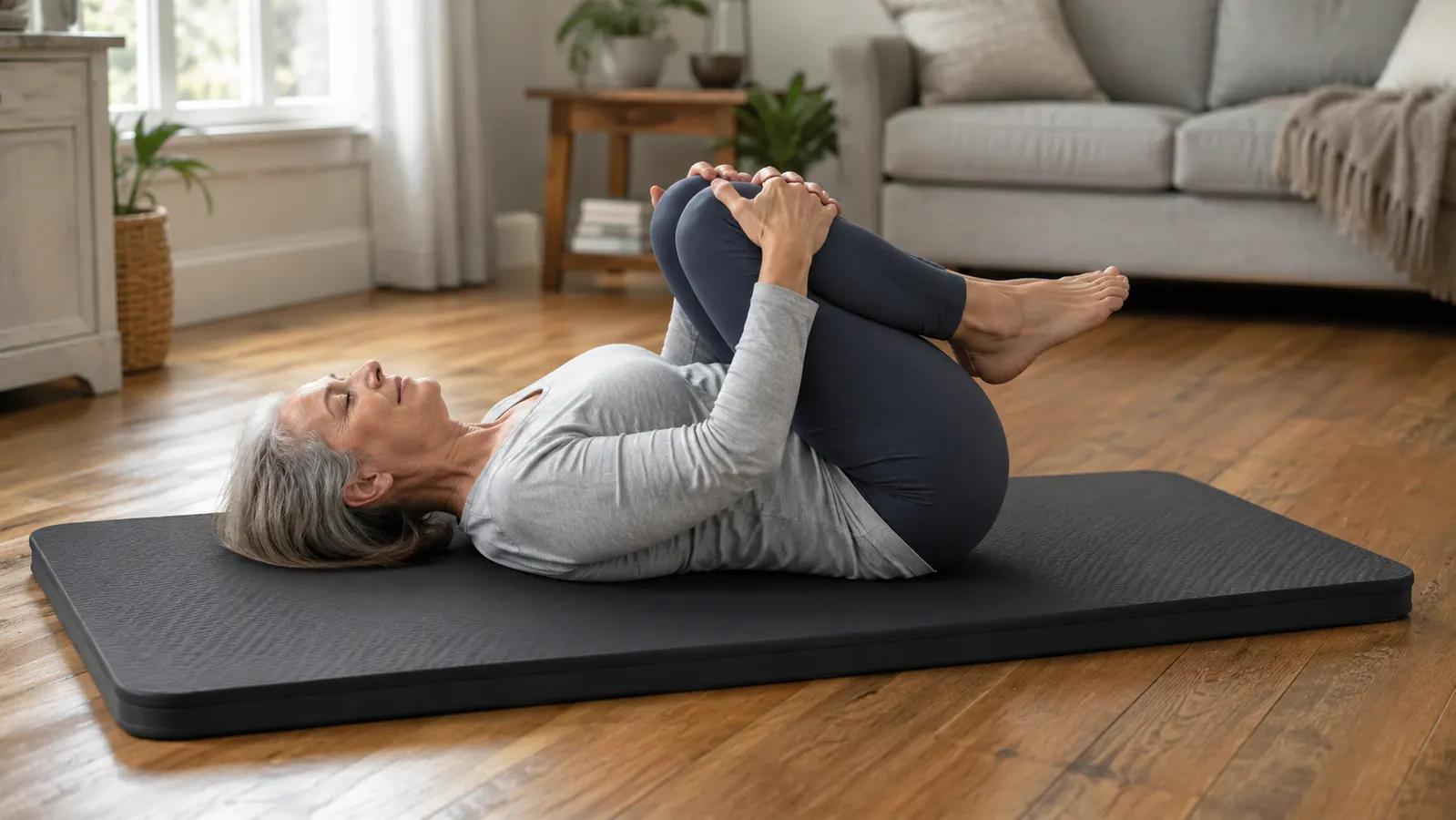
Start with the thing the marketing gets right. At one inch thick and high density, this mat is genuinely cushioned. When I kneel on it, my knees actually compress the surface instead of reading the concrete underneath. When I lie on my back and my sacrum, the base of the spine, touches down, it does not feel like I am lying on a rock. For anyone with older hips, knees or wrists, that single difference changes whether you do the exercise at all. I underwent physical therapy for my back and the floor work was the part I dreaded the least, purely because the mat took the edge off the ground.
The version I keep rolling out is sixty-eight inches long and twenty-four wide, which is enough for a full-length person to lie flat with an inch or two to spare. I am five foot six so I have room to spare, but even a taller person gets full coverage without my knees hanging off the end. The surface has a texture to it that grips my skin and my hands when I do anything on all fours. I have never slipped once on my knees, and I have put that claim through a lot of sweaty testing in July.
The carrying strap is a nicer touch than it sounds. The mat rolls up with the strap and a couple of buckles, and I have hauled it from the garage to the yard to the living room more times than I can count. It is not light, about five and a half pounds of dense foam, but the strap makes it a shoulder carry rather than a wrestle. For a person who moves the mat between rooms, that matters more than a review ever says. I would not call it a travel mat, but for home it is portable enough.
The Catch: What It Feels Like Under Your Feet
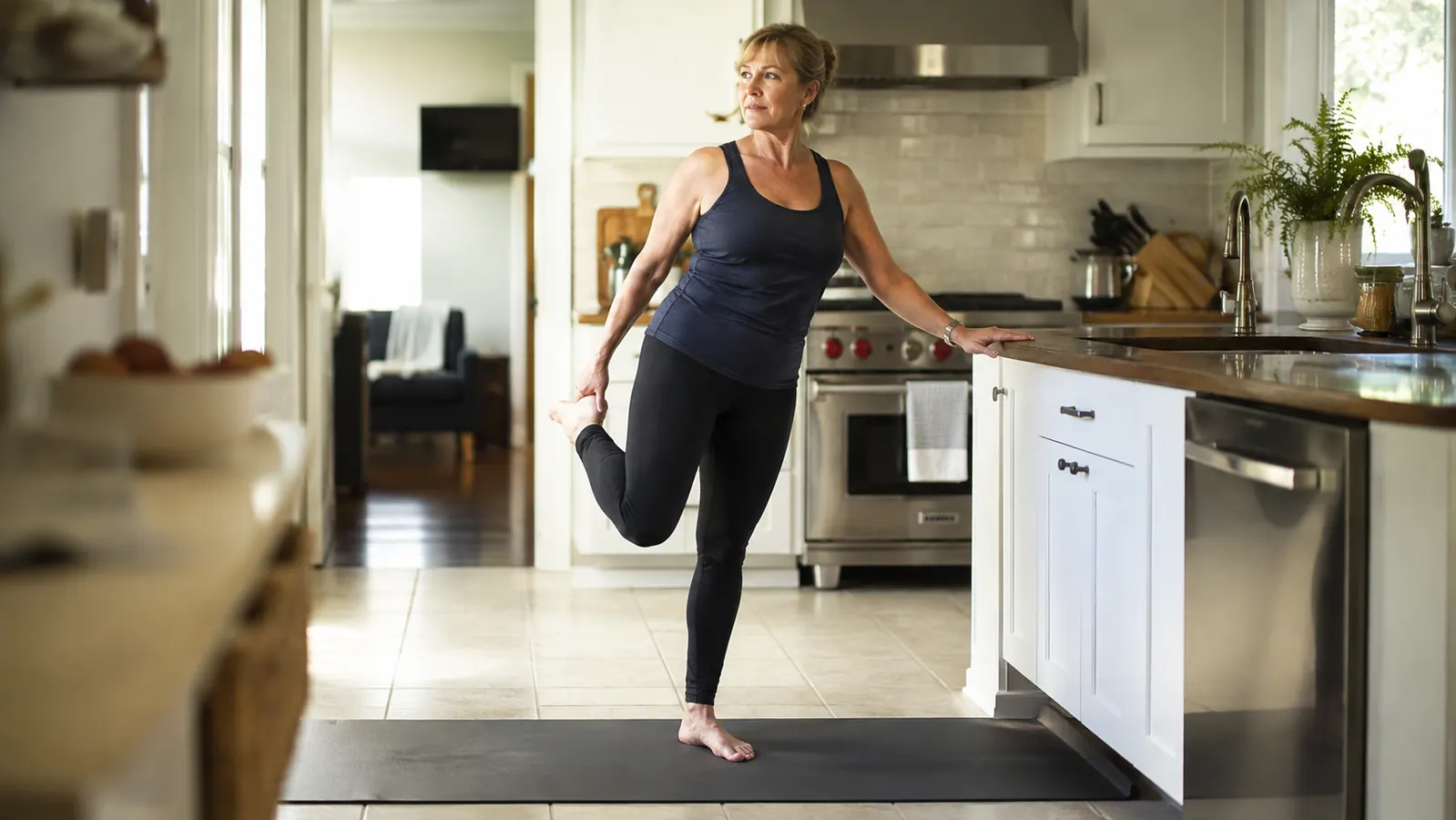
Here is the part nobody puts in the five-star reviews, and it is the reason this honest review exists. That same inch of plush cushioning that saves your knees is a liability the moment you stand on it. In any standing pose or standing balance, the mat gives under your feet like a pillow, and you can feel yourself wobbling to find the floor. On a thin mat you feel stable because you feel the ground. On this one you feel like you are standing on a slightly deflated air mattress, and your ankles have to do extra work to hold you still.
I found this out the hard way during a standing balance. I shifted onto one foot the way I always do, and suddenly my supporting leg was working twice as hard because the mat was compressing under pressure. It was not dangerous, the mat is firm enough that I never feared rolling an ankle. But it made a movement I had done for years feel shaky, and it is the single biggest reason I almost boxed this thing back up in week one.
The workaround is annoying but simple. For anything on my back, my knees or my hands, the thick mat is perfect and I use it happily. For standing work I roll it to the side and stand on the concrete, or I use a thin mat on top for the balance work. That is a two-mat life, and nobody warns you that buying the extra thick one commits you to it for half your routine.
A thick mat does not make you better. It makes kneeling bearable and standing less stable, and you have to know which half of your routine you are buying it for.
This is the honest tradeoff at the heart of every extra thick mat, not a defect in this specific one. The BalanceFrom is well built for what it is. The foam rebounds, it holds its shape after a year, and the density is consistent across the whole surface. It just is not the tool for every part of a practice or a floor routine, and no amount of five-star enthusiasm changes that.
Dents, Marks, and the Cleanup Nobody Mentions
A few smaller truths surfaced over the year. The surface shows indentation. Any dog paw, the corner of a dumbbell, or a shoe you set down too hard leaves a temporary dent that takes a while to puff back out. It always did recover for me, but a fresh impression every week makes the mat look older than it is, and I had to stop leaving the loaded dumbbells near it.
The mat also picks up and holds onto dirt more than a sealed thin mat does. In the garage it became a dust magnet, and the textured surface traps the fine Arizona grit in a way that is genuinely stubborn to clean. Wiping it with soap and water left it streaky until I figured out the trick, a damp cloth and a dry wipe after. It is not hard to maintain, but it is maintenance, and the reviews do not prepare you for the grime. I keep a small brush by the garage door and give it a sweep before I use it in the warmer months.
The roll-up is the other small gripe. Because the foam is dense and an inch thick, the mat does not want to roll tightly on its own. The strap helps, but I have to coax and straighten the edges or it flops open halfway across the garage. On the plus side, the edges lie totally flat once it is down, which is more than I can say for the thin mats I tried that curled at the corners like a bad page in a paperback.
The Heat Test
Because my mat lives through a Mesa summer in a garage that is not climate controlled, I watched it closely for the thing that kills cheap foam, heat and cold warping the shape or turning the material brittle. I am happy to report the BalanceFrom handled it better than I expected. After last August, the hottest month, the mat still lies flat, it does not stick to itself where it touches, and it does not smell. Some mats I have owned turned up a chemical odor in the heat; this one is holding its own.
The one caveat is that I do not fold it. Folding a mat this thick and leaving it folded in the heat is how you get a permanent crease, and this mat is meant to roll, not fold. I keep it rolled with the strap loose enough not to pinch the foam. That small routine has kept the surface uniform, and it is the kind of detail nobody writes down but that separates a mat that lasts from one that does not.
What I Liked
- Real, measurable cushioning that saves aging knees, hips and wrists
- Thick enough that the floor underneath never reads through
- Grippy textured surface, no slipping on hands or knees
- Full-length coverage with a shoulder strap for moving it around
- Dense foam that holds its shape for over a year of daily use, including desert heat
Where It Falls Short
- Soft underfoot, so standing poses and balances feel unstable
- Shows temporary dents from anything set down on it
- Traps dust and grit in the texture, needs regular wiping
- Does not roll up tightly without coaxing
How It Compares to a Thin Mat
If you are new to this, the honest comparison is between this extra thick mat and a standard thin one, not between two thick ones. A thin mat, the kind most yoga studios use, is about an eighth of an inch and gives up almost all cushioning in exchange for a firm, stable base. It is better for standing balances, easier to roll, and gets out of your way.
The BalanceFrom is the opposite trade, and the right one, if your limiting factor is the floor hurting you. For me, a fifty-eight-year-old with a history of lower-back trouble and honest knees that creak, floor comfort is the whole ballgame. If I am not comfortable, I do not do the work. So I bought the thick mat, accepted the wobble, and kept a thin mat around for the standing portion of my routine. If you are doing mostly seated or lying floor work, or you have older joints, that is the correct calculation.
The Bottom Line After a Year
I have gone back and forth on the rating I would give this mat, which is the most honest thing I can tell you. On the cushion, it is a solid high score, the best I have used for floor work. On the standing work, it is honestly a three. Averaged across the way a real person actually uses a mat, it lands around an eight out of ten, and the missing two points are almost entirely the underfoot stability I keep coming back to.
The reason I keep using it and would buy it again is simple. The floor does not hurt me anymore, and that has kept me doing my routine for a full year. No product that I was sold on a promise has done that for me. It took a caveat I had to learn myself, the wobble, and a second thin mat for standing work, but the main outcome is that I am still training. I would rather have an honest mat with a known tradeoff than a marketing story that falls apart in month two.
Who This Is For
This mat is for you if your reason for skipping floor work is that the floor hurts. If you have creaky knees, stiff hips, or a lower back that complains when you lie on a hard surface, the cushioning genuinely changes whether you show up. It is also right for anyone doing mostly seated, lying or kneeling routines, stretching, core work, gentle strength, or the kind of physio homework I do. If you are over fifty and getting back into training at home, this is arguably the most comfortable place to start.
Who Should Skip It
Skip it if your practice is mostly standing poses or standing balance work, where you want to feel the floor through your feet. Skip it if you need something that rolls up small and light for travel, this thing is five and a half pounds and takes up real space. And skip it if you are the kind of person who wants one mat to do everything, because this one does not hold you steady underfoot no matter how nice it feels on your back. If any of those is you, a thinner mat will make you happier, and you will avoid the wobble entirely.
For me, the answer was to stop expecting one mat to be perfect and buy the tool for the job that hurts. The BalanceFrom takes care of the floor, and I keep my thin mat for my feet. That pairing has kept me training steadily for a year, which is worth more to me than any promise a review ever made.
If the floor is what's stopping you, start here
The BalanceFrom mat is the lowest-effort fix for a hard floor I have found, and it has earned its spot in my garage. See the current price, the sizes, and the available colors before you decide it fits yours.
Amazon Check Today's Price on Amazon →