Balance is one of those things you do not notice until it is gone. I noticed mine the year I turned fifty-four, right after my lower back gave out and I spent three months bracing for every step like the floor might tilt. I was not falling, not yet. But I was grabbing the counter at the top of the stairs, and I could feel the split second between my foot landing and my body trusting it to hold. That is when I learned what the physical therapists say quietly: balance is one of the first things to fade and one of the most trainable things you own.
The fix did not look like anything I expected. I did not need a studio class that cost per session, and I did not need a room full of pilates machines. Over the last two years I rebuilt my balance in my garage using a square of carpet, a door frame, a sturdy chair, and one piece of gear I was genuinely skeptical about, the EVERYMILE wobble board. It is a flat disc on a curved base. You stand on it and the thing rocks under you. It looks about as serious as a party toy. It is not a toy, and what it gave back to my ankles, my knees, and my confidence in a stairwell is the reason I keep recommending it.
The Balance Tool That Eased My Unsteady Feet
After a back episode left me wobbling on the stairs, a wobble board did more for my balance than a year of half-hearted stretching. See the today's price on the EVERYMILE board and whether it belongs on a carpet square in your own home.
Amazon Check Today's Price on Amazon →The Five Steps That Rebuilt My Balance
Before the steps, two ground rules, because this is the part everyone skips and the part that keeps you off the floor. First, have a support nearby for every single exercise. A counter, a chair back, a door frame, all of them are fine. Using support is not cheating, it is the whole method. Second, if you have an acute injury, dizziness, or anything a doctor is already watching, clear every one of these with that doctor first. I am a reviewer with a garage, not a medical professional, and what worked for my lower-back episode is a plan to talk about with your own care team.
I used a little kitchen timer for the timed parts and kept a running note in a spiral notebook, two seconds here, four seconds there. Progress on balance is quiet and it does not show up in the mirror. Writing down the number is the only way I could see that I was actually getting steadier, and on the discouraging days, that notebook was what kept me going.
Step 1: Stand Up From a Chair, Over and Over
I started exactly where the physical therapist directed me, with sit to stands, because rising from a chair is a balance exercise hiding inside an everyday habit. Sit tall near the front edge of a sturdy chair, feet flat and hip width apart, and stand up without using your hands. Pause at the top for a full breath. Then lower yourself slowly, as slowly as you can, without flopping. That slow lowering half is where the hip and thigh stabilizers earn their keep.
I did ten of these at a time, three times a day, in the week I was afraid to do anything else. If ten felt easy I slowed the lowering until the movement took a full count of five each way. If my hands kept reaching for the arms of the chair, I left them there at first and worked on rising tall from the seat. Six weeks of this and my body remembered it could stand without telling my brain first, which is the whole point of balance work in the end.
Step 2: Shift Your Weight Like You Mean It
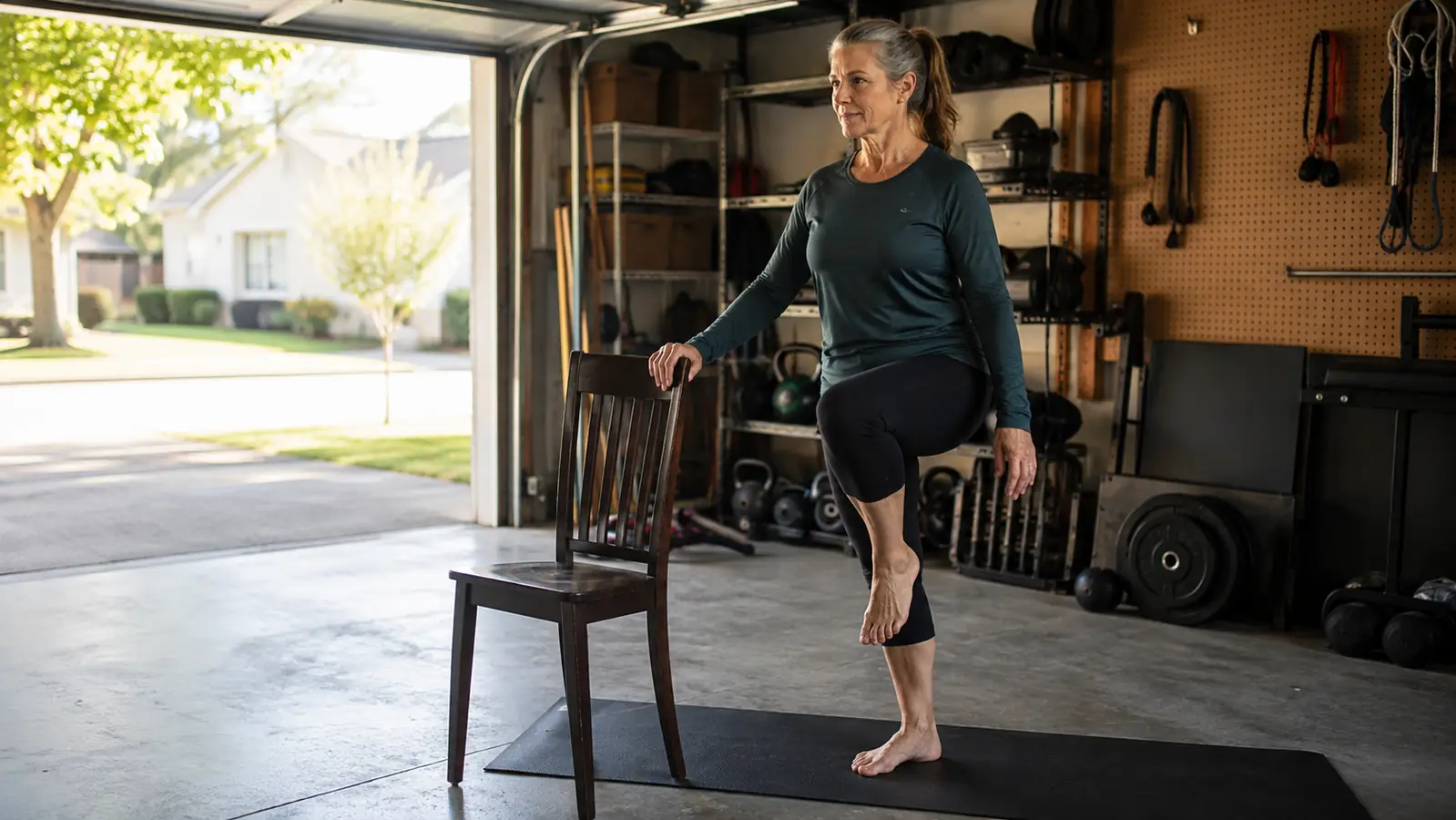
The next step is weight shifting, and it is the most underrated move in the whole plan. Stand with your feet hip width apart, a hand hovering an inch off the counter in front of you, and slowly roll your weight onto your right foot until your left heel lifts. Hold for two breaths. Roll back to center, then onto the left. That is one rep. The exercise looks so simple you feel silly doing it, but it teaches your ankle to keep a limb steady while the other one takes charge, which is the exact job your ankles do every time you catch a toe on a rug.
I pulled a chair sideways in front of me and let my fingertips rest on its back while I did fifteen slow shifts each side. The rule I kept was to move slowly enough that my body never had to catch me. If the chair back took more than a light touch, I scaled the movement back. Balance work is not a test of grit, it is a lesson in not needing grit in the first place.
Step 3: Time Yourself on One Leg
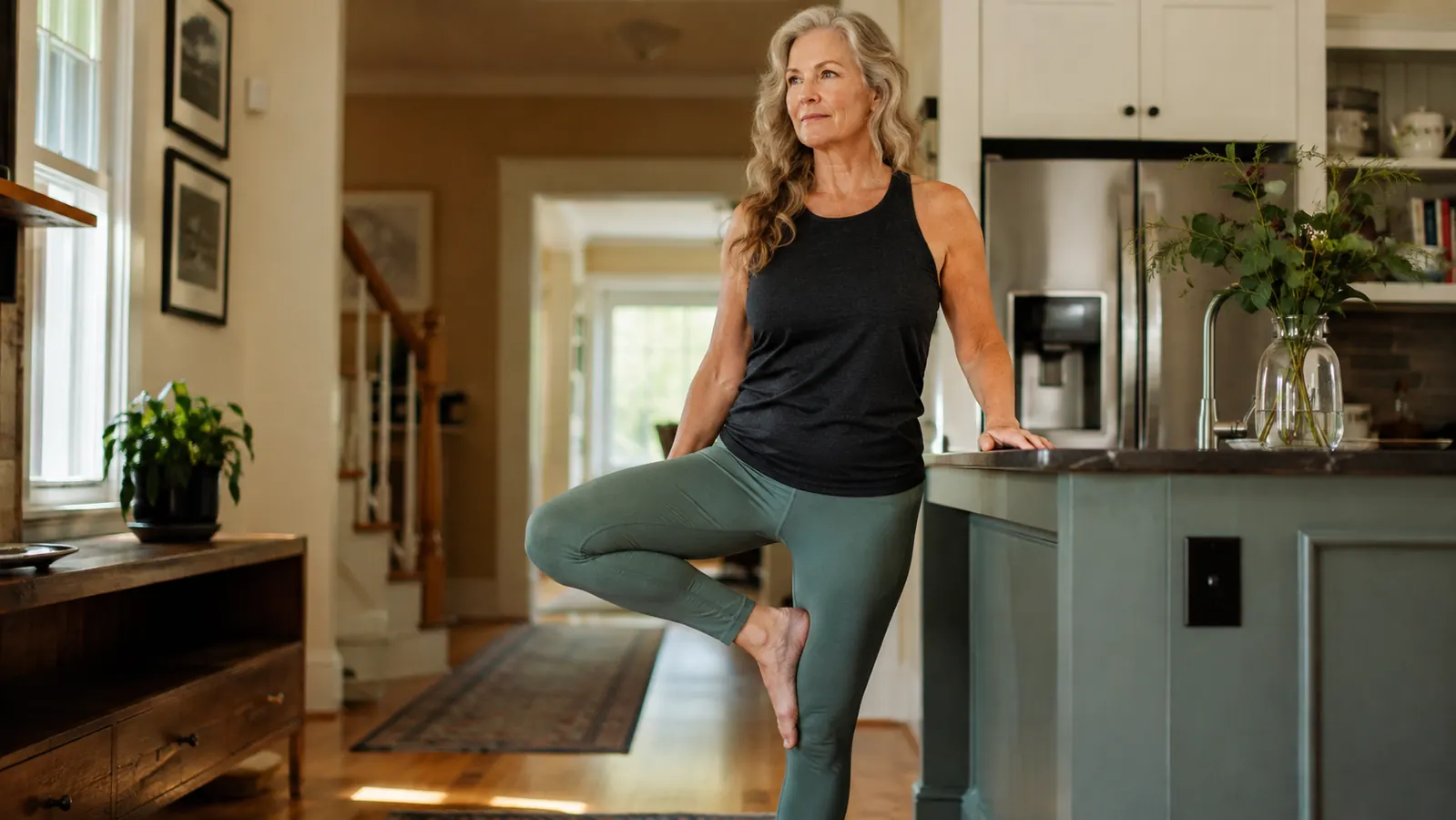
Single-leg standing is where most people panic, so I will be honest about how unsteady you feel at first. I was a shaky fifteen seconds on my first day and I have heard that exact number from half a dozen people over fifty who tried it after me. Stand near a counter, lift one foot an inch off the ground, and let your eyes find a fixed point straight ahead. Hold until you wobble, then set the foot down, no penalty for a short first try. Switch sides.
The improvement here is fast and measurable. I went from a wobbly fifteen seconds to a steady forty-five in about a month of doing this twice a day. Keeping my eyes on a fixed object instead of my feet made more of a difference than any muscle trick, and I stopped closing my eyes when I got proud, because closing your eyes destroys balance and a grab for the counter is a lot closer than it looks. Hold near that support, always. Boredom is your sign to progress, not to skip the support before you are ready.
Step 4: Meet the Wobble Board
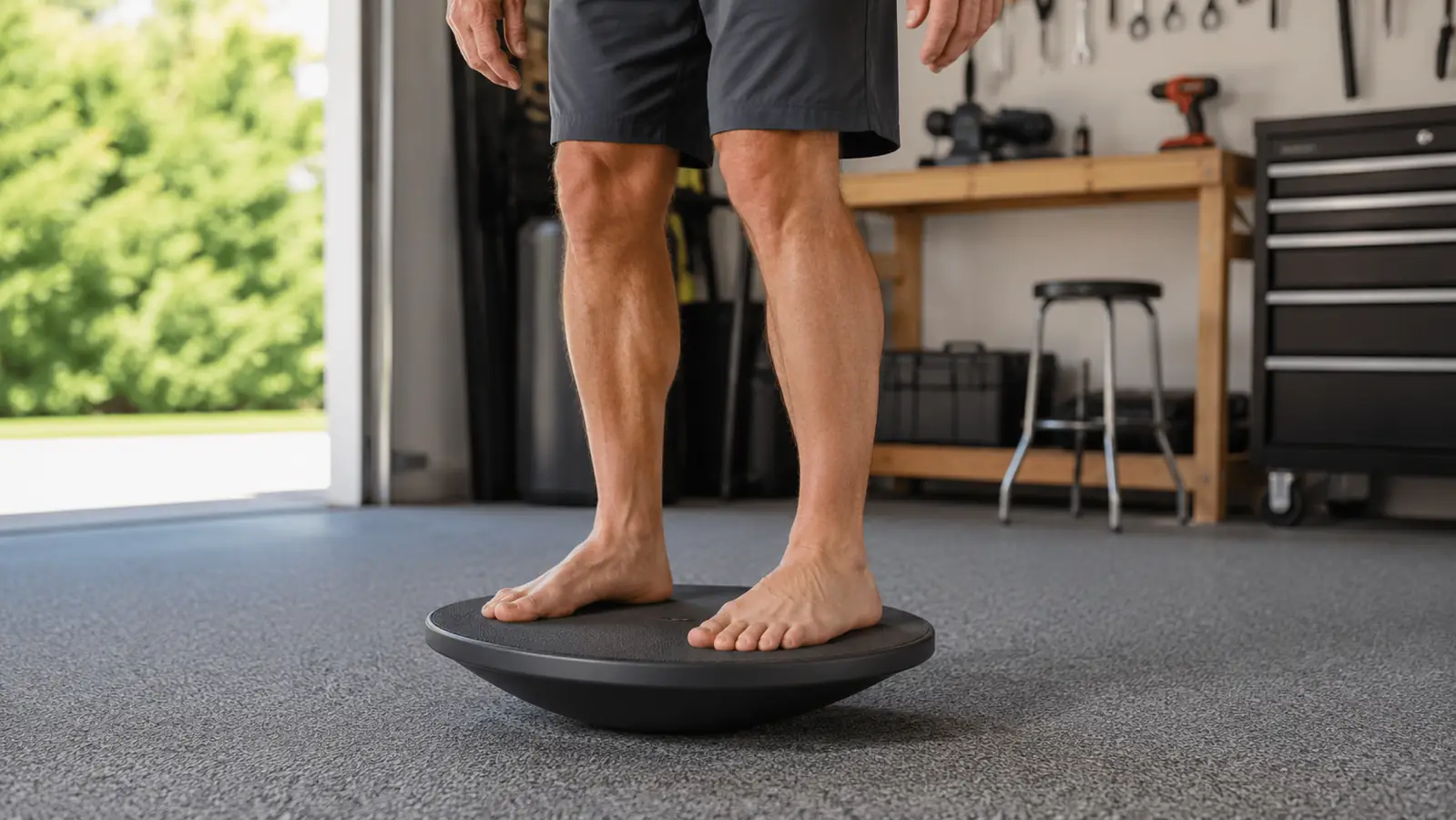
Once single-leg standing stopped feeling like a coin toss, I brought in the EVERYMILE wobble board, and this is where the real work started. The honest version is that the first session humbled me. The board rocks, and every instinct I had grabbed for the wall. I kept a chair in front of me and did not leave it. I stood with my feet hip width apart, let the board find its own resting rock, and just tried to hold still for twenty seconds without the edge touching the floor.
The surface is where this board earns its keep. The no-skid top held my bare feet without slipping even when I got sweaty in the Arizona heat, which is the thing I worried most about, and I have never felt the edge roll out from under me the way cheaper smooth boards did in stores. That grip matters, because a board you trust is a board you will actually stand on daily instead of leaving in a closet. A few minutes of this a day also carried straight into my strength sessions, where the unsteadiness under my feet made my normal squats and presses feel suddenly solid by comparison.
The tradeoffs are real and I will name them. The EVERYMILE board is genuinely harder than the step-by-step earlier moves, so it is the wrong tool for week one. It is also not a substitute for medical rehab or for a doctor's care on an acute injury, and if your balance trouble comes with dizziness or vertigo, this is the wrong thing to self-prescribe. And you will need a bit of space and a stable floor, the board does not care for thick plush carpet. On a thin mat or bare floor it shines.
Step 5: Turn Ten Minutes Into a Habit
None of these exercises do you any good sitting in a notebook, so the final step is the habit, and the honest secret is that ten minutes beats a perfect hour you will skip. I attached my balance work to something I already did every morning, my first cup of coffee. While the water boiled I did my sit to stands and weight shifts on the kitchen mat. When I carried the cup to the garage chair, I did my single-leg timers. The board sits on the carpet square full time, so I step on it for one minute while I pick a playlist, often still holding the chair.
The number that finally made it stick for me was the consistency, not any single session. Two years in, I still do not look impressive, there is no photo op here, and I do not spend hours at it. But I climb the stairs at my daughter's house two at a time now, and I stopped bracing for the shower floor. That is the actual goal, a body you can trust on an ordinary Tuesday.
What Else Helps
Balance is a whole-body job, so I pair the board work with a few cheap additions that all live in my garage. Walking, even twenty minutes a day, keeps the ankles and hips moving the way they are meant to. A thin mat between me and a hard floor saved my knees and made me willing to practice at all. And the core work I do separately, nothing fancy, just planks and slow leg lowers, does double duty, because a stiffer trunk gives the wobble board less to correct.
One more tip that cost me nothing: I stand on one leg while I brush my teeth, holding the counter with the other hand. It is the whole drill compressed into two minutes, twice a day, with zero excuses available. The tiny daily reminders are what make the structured sessions count.
Two practical things I learned the hard way after decades of home training. First, do the balance work in shoes or bare feet you can feel the floor in, not squishy slippers that hide the wobble, because the whole point is feeling that unsteadiness before it becomes a fall. Second, keep a towel and a bottle of water within reach so you never leave your support to fetch them. Small as both sound, they are the difference between a routine that survives a month and one that dies on the first hot day.
Two years in I stopped bracing for the shower floor. That is the actual goal, a body you can trust on an ordinary Tuesday.
My Everyday Balance Board, After Two Years
The EVERYMILE board is the piece of gear that turned a scary handful of seconds on one leg into a morning routine I actually keep. It is a small, real-tradeoffs tool, not a miracle, and if your balance has started to wobble, it is worth a slow start. Check the current price and pair it with the five steps above.
Amazon Check Today's Price on Amazon →