Most of the questions I get from people my age all boil down to one: how do I start lifting weights at home without hurting myself and without turning the spare room into a gym? I understand that question, because I put it off for years. The gym membership I signed for in January got used twice. The YouTube routines all assumed I had a spotter, a barbell, and a shoulder that did not complain. And every program I clicked past promised a transformation in eight weeks and delivered a sales pitch by paragraph three. I stopped trusting the whole category.
Four years ago, a lower-back episode put me on the kitchen floor of my house in Mesa, Arizona, and a physical therapist told me something I did not want to hear. The strength I had lost was not coming back from rest. It was coming back from lifting, and lifting was exactly what scared me. What saved me was a plan that was honest about how slow progress really is, plus one pair of weights that made everything simple. That pair was the FEIERDUN DS2 adjustable dumbbells, and they are still on the same bench today. In the next few minutes I will walk you through the exact five steps I used, including the mistakes I made first so you can skip them.
One Pair That Spans Light to Heavy Without a Rack in Sight
The FEIERDUN DS2 is the piece I would buy again first. One pair covers the light settings I started on and the heavier ones I use now, and the connector bar turns both dumbbells into a short barbell for floor presses and rows. Check today's price and see if it fits your corner.
Amazon Check Today's Price on Amazon →Step 1: Get the Green Light From the Person Who Treats You
If you are over 50 and anything has ever gone sideways with your back, knees, shoulders, or heart, the fifteen-minute check-in is not a formality. A doctor can catch the things you would not think to ask about: blood pressure that spikes when you hold weight overhead, a medication that makes you dizzy on a quick stand, an old injury that changes which movements are safe for you. One honest conversation before you start saves a month of guessing after you start. That is cheap insurance.
Talk to your doctor or the physical therapist who treated you, not an internet forum. When mine cleared me to lift, he gave me two rules I still follow: no bending forward under load in the early months, and no grinding through a joint that pinches or aches. He did not hand me a program. He handed me boundaries, and the boundaries are the reason every step after this one felt safe. If your own doctor tells you to skip something I suggest, that person wins. Always.
One more thing belongs in step one, and I almost never see it written down: tell a person what you are doing. A spouse, a sibling, a neighbor who also lifts. Somewhere around week six you will have a morning you do not want to train, and having told someone makes you show up anyway. The social part is not softness. It is the difference between a four-year streak and another January membership.
Step 2: Clear a Six-Foot Square You Can Leave Set Up
Here is a practical truth no gym advertisement tells you: the routine you actually keep lives somewhere you can leave it. When I started, I cleared a six-foot square of garage floor, put down a thick mat, and swore that spot was off limits to recycling bins, patio furniture, and the boxes I meant to donate. Knowing the space was waiting for me removed the whole set up and break down excuse before it could form, and that excuse is how most home gyms die.
Do not buy a roomful of equipment to fill the space. Buy the floor covering, buy one bench or a sturdy chair, and stop there. The BalanceFrom extra-thick mat I trained on for the first year is the difference between a completed floor press and a skipped one on a cold morning, and it packs up with a carrying strap when company comes. A corner of a bedroom works exactly as well as my garage does. What matters is that the spot stays yours.
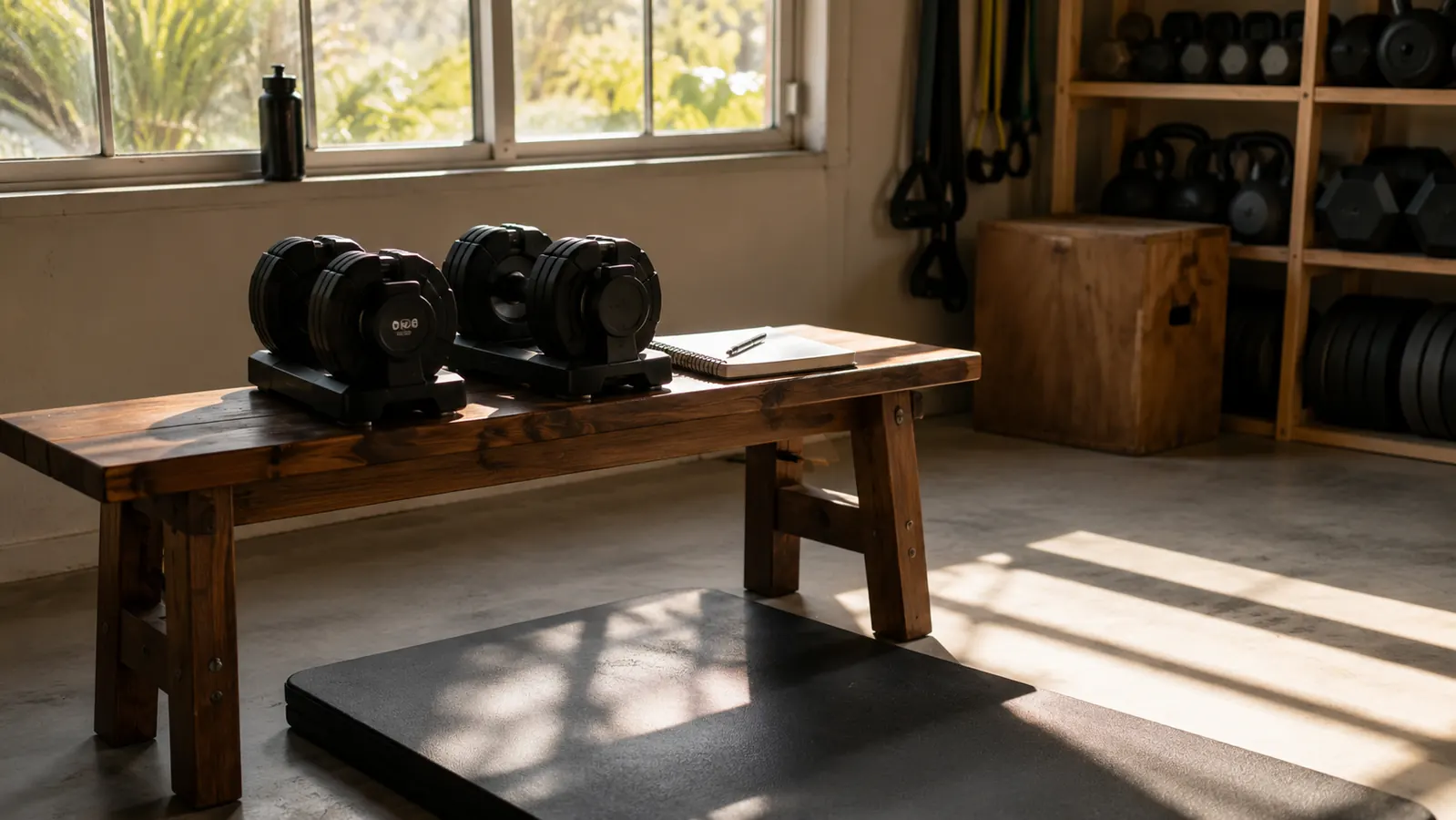
Here is a small tip that matters big: keep the weights visible. The equipment we buy and bury in a closet dies there because it is out of sight. My FEIERDUN pair lives on the bench, in the open, and what you walk past every day is what you use. Out of sight is out of the routine.
Step 3: Buy One Pair of Weights You Can Grow Into
This is the step most people get wrong, and I got it wrong twice before I fixed it. I bought a starter set of fixed dumbbells first, five pairs, and they became a storage problem in about eleven days. Then I bought a single pair that was too light and outgrew it in a month. The right answer is one pair you can change as you get stronger, because the whole game of strength is adding a little weight over a long time, and nothing kills that game faster than a rack of weights you have to store somewhere.
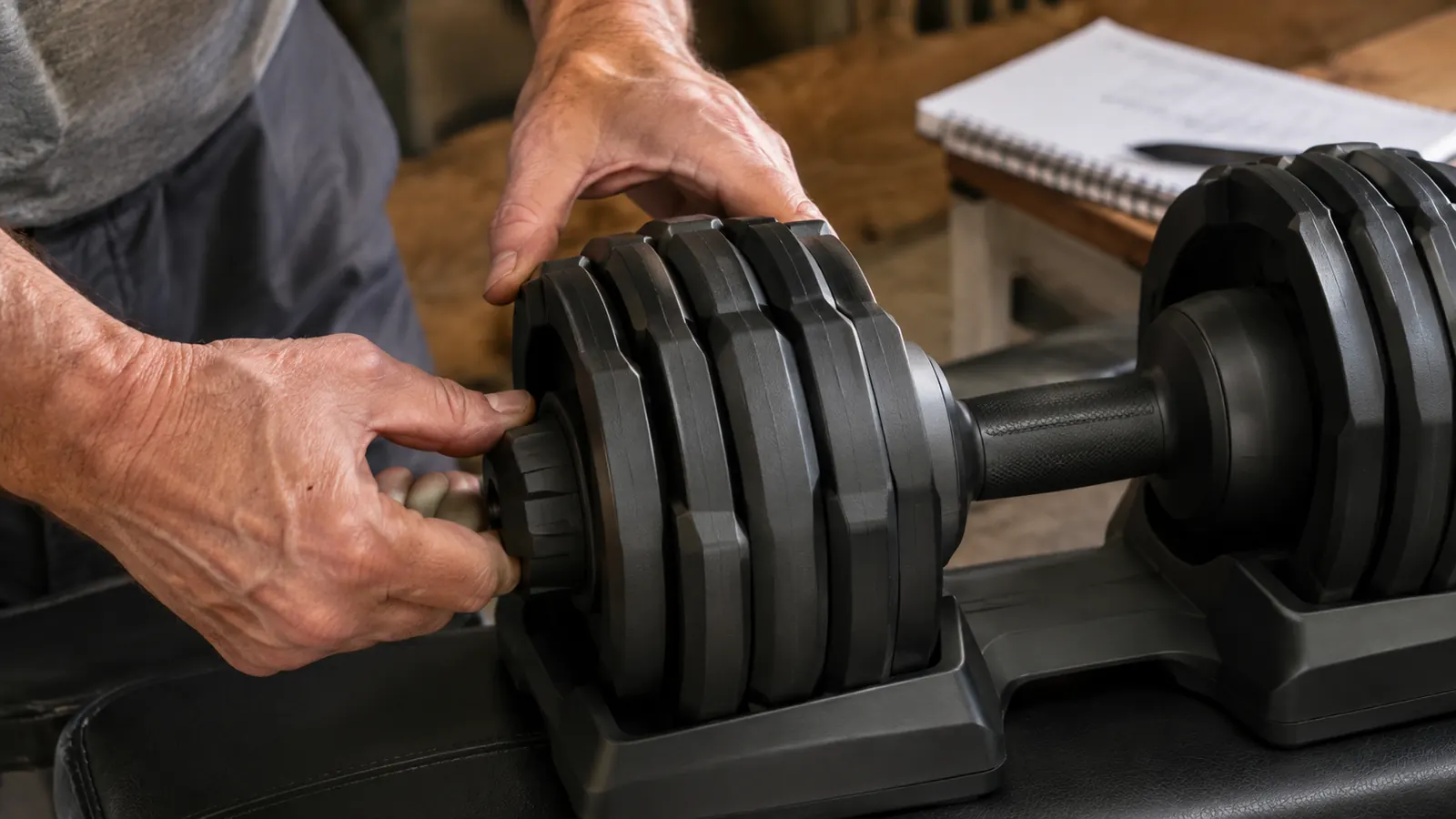
The FEIERDUN DS2 adjustable dumbbells are what I settled on, and they are still on my bench four years later. One pair covers the light end I needed in week one and the heavier end I work with now, and changing the weight takes seconds once your hands know the collar. The connector bar that ships with them turns the two dumbbells into a short barbell, which matters more than you would guess for floor presses and rows in a tight space. They hold a 4.4-star average across nearly 5,000 Amazon ratings, and that matches my four years: no drama, no broken parts, just work.
I am not going to pretend the DS2 swaps weight as fast as a spring-loaded dial system, because it does not, and it costs more than a single fixed pair. But it does the thing that actually keeps people my age training: it lets you creep up in small steps instead of big jumps, and a big jump is the most common way an over-50 lifter gets hurt. I wrote the long version of how this pair has held up in my full FEIERDUN DS2 review, and if you are weighing one pair against a starter rack, I also put together ten reasons adjustable dumbbells beat fixed weights.
Step 4: Learn Five Movements, Not Forty Exercises
Strength training does not need a menu. Every useful exercise is a version of five movements: squat, hinge, push, pull, and carry. Do one exercise from each group and you have trained your whole body for the day. You can memorize that list in under a minute, which is better than paying for a program that hands you forty variations of three different curls and calls it science.
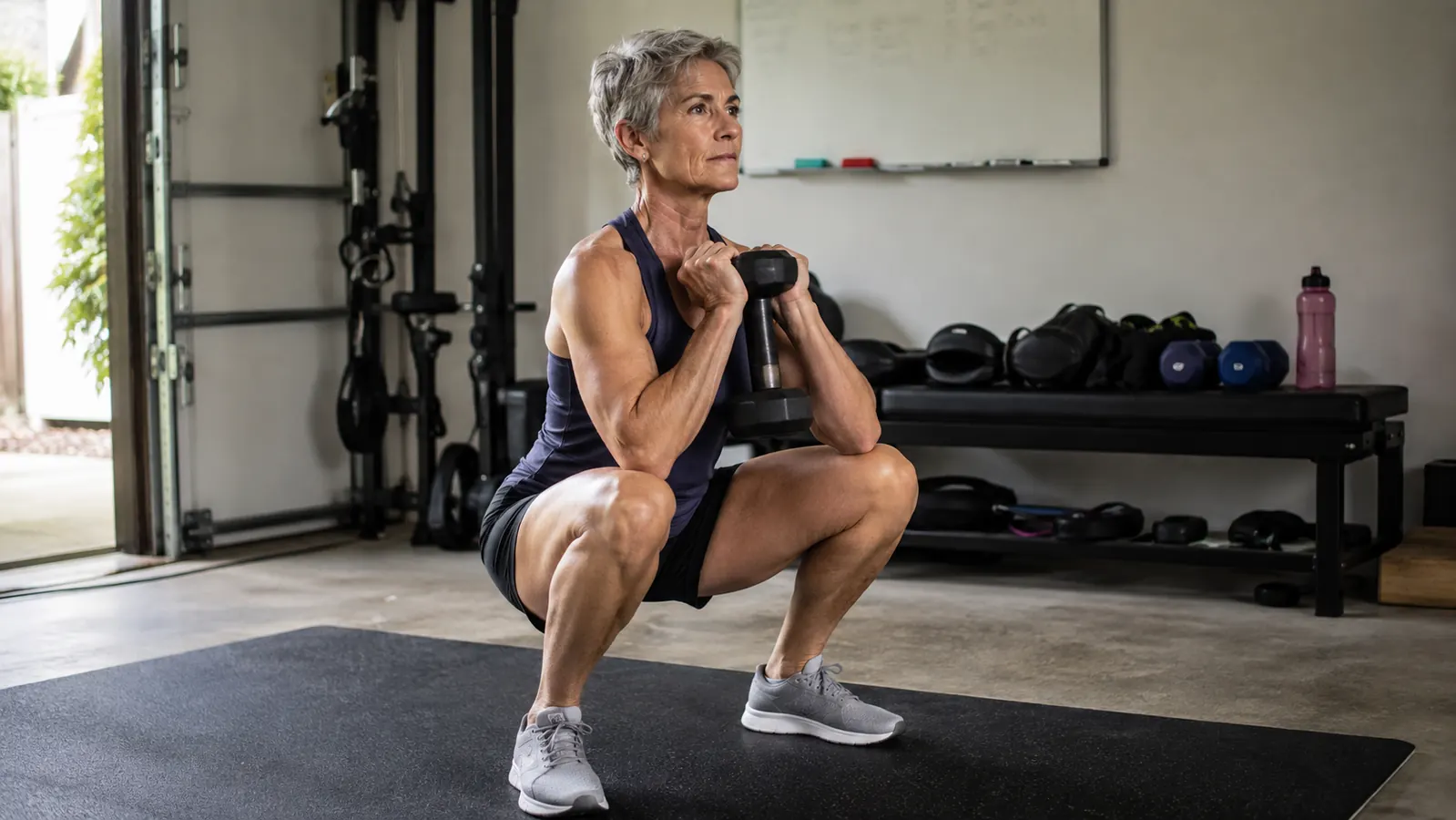
Here is the first four-week menu I would hand to a friend my age, trained in a six-foot square with one dumbbell. Goblet squats, with the dumbbell held at your chest. Incline push-ups against the bench or the counter. Single-arm rows from that same bench. A hinge, which means a deadlift-style movement where you push your hips back and keep your back flat. And a farmer carry, walking with the dumbbell in one hand while you keep your chest tall. Three sets of eight to twelve reps each, with sixty to ninety seconds of rest between sets, two days a week.
The pace gauge is one sentence: you should be able to talk between reps. If you cannot get a few words out, the weight is too heavy, so drop it down a step. If a movement makes a joint pinch or ache, do not power through it; find the version that does not, and there is always a version. Form first, weight later. Nobody in this house is chasing a record. We are chasing a routine we can still be doing next year, and so far it is working.
Step 5: Write It Down and Add a Little Weight on a Schedule
Progressive overload sounds like a term from a fitness magazine, but in plain English it means one thing: do a little more than last time, and prove it to yourself in writing. I keep a spiral notebook on the bench, one line per session, with the exercise, the weight, the sets, and the reps. That notebook is the most valuable piece of training gear I own, because memory flatters and paper does not. When week three feels flat, the notebook tells me week one was worse, and that is a quiet kind of fuel.
The rule I use is boring on purpose. When I hit three sets of twelve twice in a row with clean form, I bump the weight a small step at a time. With the FEIERDUN that is a quick turn of the collar, not a trip to the store. Some weeks the number in the notebook does not move, and that is allowed. Twelve weeks in, you notice the difference in the stairs and in the groceries. It is not a transformation you would post about. It is a dependable return of strength, and I will take dependable over dramatic every time.
Two days a week is an honest floor, and three is better if the schedule allows. More than three days of loaded hinge work with a creaky joint is often too much. Listen to the body that has to carry you to the mailbox. If the lower back that started all of this for me barks the day after, the answer is usually a lighter weight, not a longer rest. Adjust the dose before you adjust the goal.
What Else Helps (and What You Can Safely Skip)
Three things make the weights do their job, and none of them are flashy. A mat you do not dread lying on, flat-soled shoes or bare feet, and a rest day between sessions. The BalanceFrom mat I keep mentioning has outlasted every other cheap piece of gear I own, and on the days my back grumbles it is the cushion that decides whether I train or sit. Soft running shoes on a garage floor give you a wobbly base for a hinge; socks or flat soles are steadier.
Protein at each meal and a full night's sleep do more for recovery than any supplement ever will. Skip the powders, the capsules, and the creams that promise to optimize something. Your body rebuilds on food and rest, and every dollar spent there is a dollar that actually works. If your doctor has specific notes about your diet, do that instead.
Here is what you can skip with a clear conscience, and I say this as someone surrounded by gym gear: machines that take up a whole room, apps that bill you monthly, and any program that promises to transform you in weeks. If a plan needs its own vocabulary and a payment plan, it is selling, not teaching. Your body responds to consistent, boring, slightly heavier work, and it does that for free. Trust the boring.
The notebook on my bench shows I have bumped the weight on the FEIERDUN eleven separate times in four years. Every one of those bumps came from a written log entry, not from a feeling.
If You Buy One Piece, Make It the Weights
Five steps, one pair of weights, and a six-foot square of floor you can leave set up. That was my honest plan, and it is still my plan four years later. The FEIERDUN DS2 is the piece that made growing into it possible. Check today's price on Amazon and see where it lands for you.
Amazon Check Today's Price on Amazon →