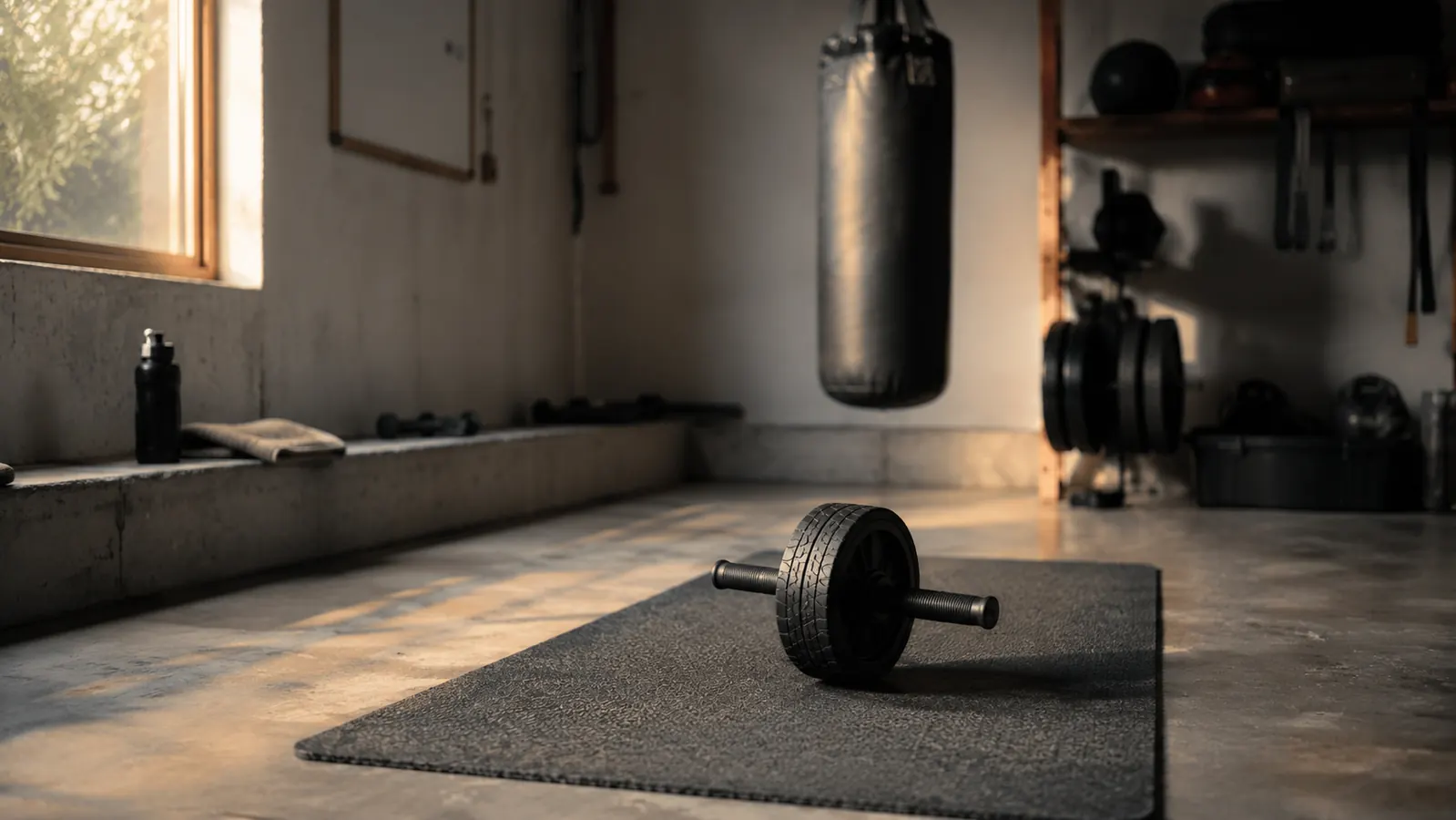
I will tell you the honest reason I bought an ab roller. It was not because I felt ready. It was because four years after a lower-back episode that flat put me on the living room floor for a week, I had run out of core exercises I could actually do. Sit-ups torqued my back. Planks got boring and my form wandered. Crunches felt like they were working my neck more than my gut. So I ordered the Luyata 10-in-1 kit mostly out of spite, expecting to hate it, the way you expect to hate a dentist appointment. Instead it has earned a permanent spot on my garage floor.
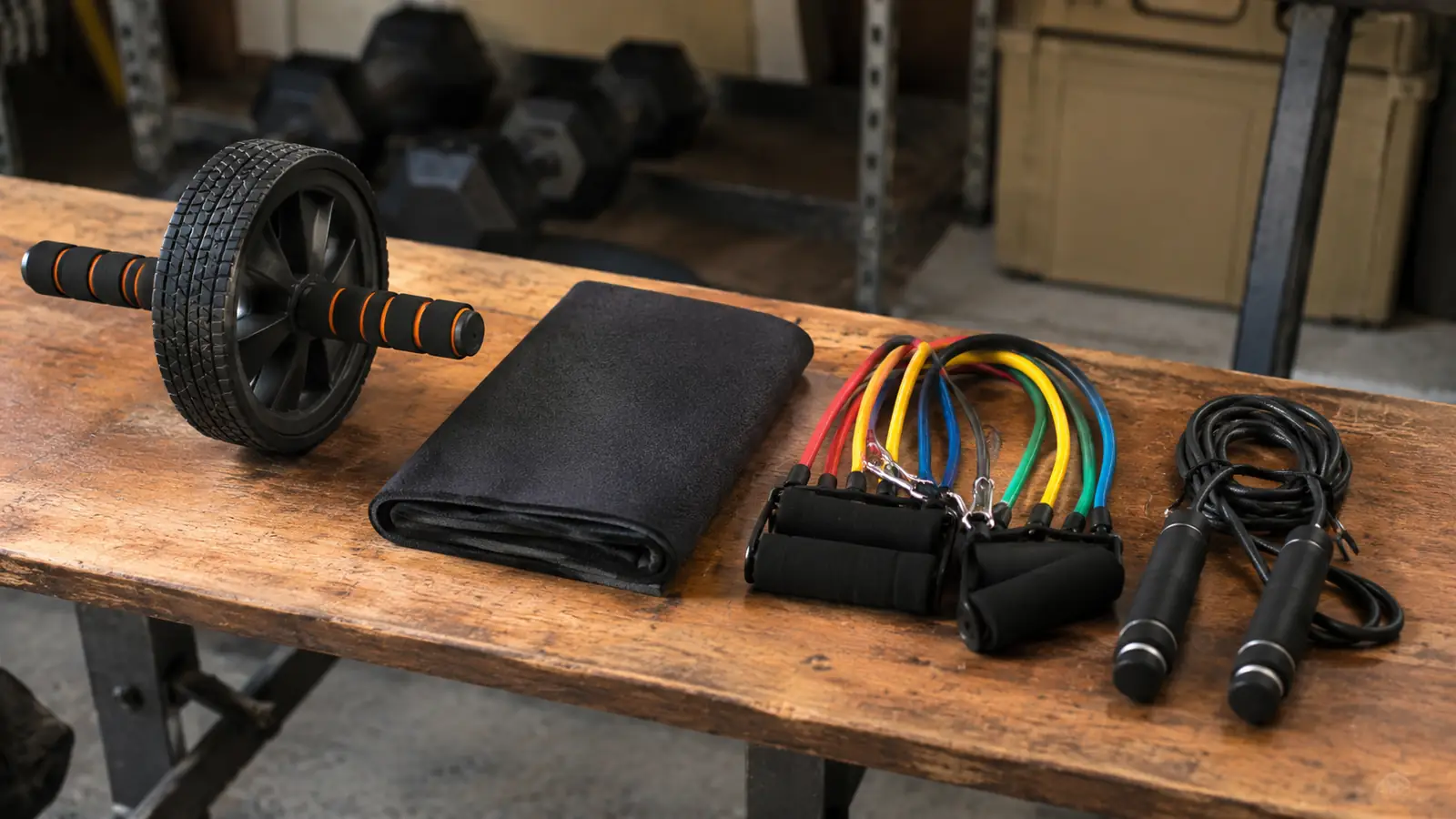
I have used it almost daily for four months now, and I want to be straight with you about what it is and is not. It is a simple wheel on a frame, a padded knee mat, a pair of resistance bands and a jump rope bundled together for less than the machine I used to half-want at the gym. What matters is the movement and whether you will actually do it. The packaging calls it a 10-in-1 kitchen sink of core gear, but the wheel and the knee mat are the honest heart of it. This is my long-term review of that, written from my garage in Mesa, not from a spec sheet.
The Quick Verdict
An affordable wheel that is easiest to recommend when you take the knee mat seriously and build up from half rollouts instead of trying to be clever on day one.
Amazon Check Today's Price →If you have been meaning to fix your core without a gym, start where I did
The Luyata kit is the exact setup sitting on my garage floor right now. Check the current listing to see the build and the included pieces.
Amazon Check Today's Price on Amazon →How I've Used It
My setup is a squat stand, an adjustable bench and a few free weights in the garage, and I train three to four mornings a week at about 6:30, before the Arizona heat gets anything done. The ab roller goes at the end of every session, after my lifts, because that is when my back asks for a little respect instead of a workout. Four months ago I could not do one full rollout without my hips sagging into the floor and my lower back saying I had made a serious judgment error.
So I started stupid-simple. Knees down on the mat, hands on the wheel, and I only rolled out as far as I could hold a dead-straight line from my knees to my shoulders. Some days that was eighteen inches. Some days it was barely past my elbows. The wheel does not care how clever you feel, and that is its best quality. I logged sets in a spiral notebook, three sets of five, twice a week for the first month, and I let the distance come on its own.
By the end of the second month I could hold a full rollout and drag back without my hips collapsing. That was the moment I stopped seeing it as a gimmick. If you are over fifty and your core has gone soft, this is one of the few inexpensive tools that punishes you exactly in proportion to how weak you are, and rewards you exactly in proportion to how consistent you are. Nothing else in my garage does that as plainly, and nothing I tried in the expensive gym days did it for me either.
The Wheel Itself
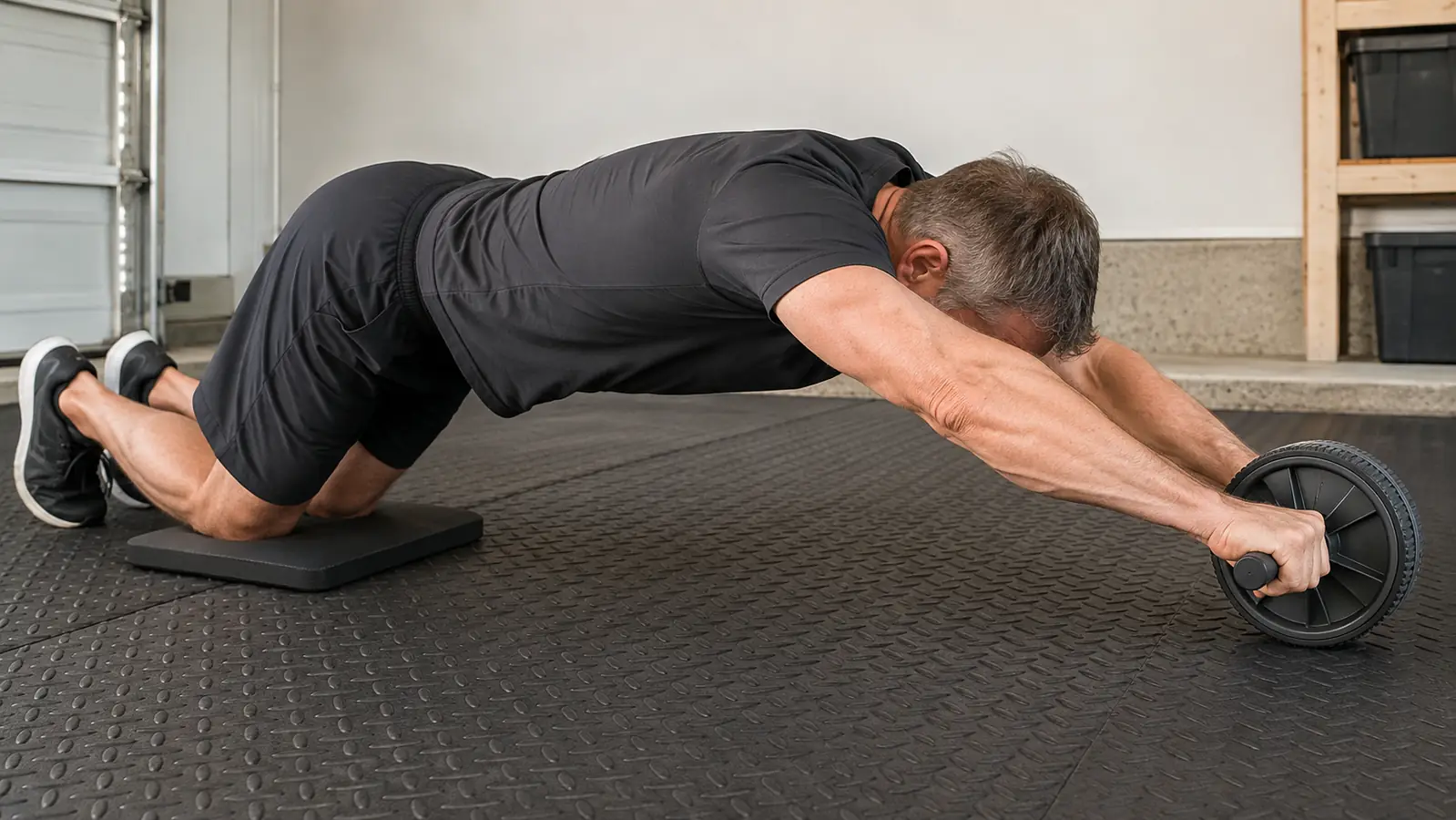
The Luyata wheel is wide, which sounds like a small thing and is actually the whole thing. A wide twin-wheel base means it does not want to twist on you mid-rollout, and that stability is what makes the movement safe for a middle-aged back and shoulders. I have used skinnier single wheels at a friend's place and they are harder to control. The wider stance forgives a little wobble, and at our age we appreciate a tool that forgives.
The grips are padded and long enough for two hands with room to spare, which matters once your arms tire and your grip starts to wander. The wheel rolls smoothly on my garage concrete and on a rubber mat, and I have not noticed any rough spot or bearing wobble after four months of near-daily use. The handles are solid and have not loosened on me. It has picked up some garage dust on the tread, and once I noticed a faint squeak over the concrete that a damp cloth fixed in under a minute, so I keep a rag by the bench now. Nothing has cracked or gone hollow, and the frame still feels dense in my hands rather than like a cheap shell. For an inexpensive kit, the core piece is built honestly. I half expected it to feel like a toy in the box; it does not.
The Movement, and Respecting Your Back
Here is the honest part that almost nobody puts in a review. The ab roller only helps your back if you use it with a braced core and a flat spine, and that is much harder than it looks from the product photos. The first time I rolled out, my ego told me to go long, and my lower back arched, and I felt a twinge that sent me back to conservative range for two weeks. That twinge was not the wheel's fault. It was mine, coming in here acting like I was twenty-five.
The fix is a movement you have to slow down on purpose. Tuck your hips, squeeze your glutes, tighten your belly before you move, and roll out to the exact point where your torso still holds a straight line from your knees to your head. Stop there. Come back slow. That is a rollout done right, and it is genuinely hard even when it looks small. The Luyata wheel gives you a stable platform to learn it on, which is more than I can say for a lot of the core gadgets I have wasted money on over the years.
Getting Past the First Two Weeks
If you buy one of these, the danger is not the wheel. The danger is the second week, when the novelty wears off and your side abs ache in a way no one warned you about. I want to tell you plainly that soreness happens, it is normal, and it is not a reason to quit. Day five I woke up sore in places I did not know I had places. I cut my sets in half, gave myself a couple of rest days, and eased back in. By the end of week three the ache was gone and the distance had grown on its own. The other thing I learned in that stretch is to space the sessions out rather than stack them, because three good mornings a week beat five sloppy ones, and my midsection needed the recovery days to actually respond.
My advice, for what it is worth, is to treat it like a habit and not a heroic effort. Keep the wheel out where you will trip over it. Do your two or three small sets, and do not count the perfect rollout, count the day you showed up. That consistency is what builds a stronger midsection, and a stronger midsection is what your back actually needs. The wheel is just the honest tool you happen to be using while it happens.
What the Mats Are Actually Worth
The padded knee mat is the unsung part of this kit, and I am naming it specifically because so many people buy a bare wheel, quit after one session of rug-burned knees, and blame the exercise. On my garage concrete, the included mat is the difference between doing the work and not doing it. It is thick enough to kneel on comfortably for three sets, and wide enough that my knees stay planted without hunting for the edge. Do not throw it in a drawer. Use it.
The resistance bands and jump rope that round out the 10-in-1 marketing description are fine, but they are honestly extras. I use the bands occasionally for resisted pull-throughs, and the jump rope has sat coiled on my bench since about week two. The kit earns its keep through the wheel and the knee mat. Everything else is a pleasant bonus you should not pay a premium for, and you are not, which is the nice thing about the price point.
What Four Months Did for My Back
I need to be careful here, because I am not a doctor and I am not going to promise you anything. What I can tell you is my own experience. Four years after my back episode, my mornings used to start with a slow, careful teeter out of bed until my spine warmed up. Around the start of the third month of regular rollout work, I noticed I was stepping off the curb without thinking about it, and getting up off the garage floor where I train without that bracing, anticipating-a-twinge hesitation. The quieter change was in the mornings. I used to swing my legs out sideways off the bed, careful, before I trusted my back to hold. These last few weeks that knot under my shoulder blade is mostly a stranger, and standing up is just standing up.
Is that the wheel or the general habit of training again? I cannot fully separate the two, and I will not pretend I can. What I can say is that no other single piece of equipment made my midsection feel stronger faster, and a stronger midsection is what many physical therapists told me my back needed after the episode. That connection, between the core work and a quieter back, is the reason this wheel still sits on my floor instead of gathering dust with the other good intentions.
The Tradeoffs, Honestly
Two things I want you to know before you buy. First, the ab roller is not a miracle machine and it is not a fat burner. It is a tool for one thing, core strength, and if you are looking for a quicker fix, this will disappoint you. Second, it demands better form than it looks like on the box, and you have to be willing to start embarrassingly small. If you are not ready to be humble on the garage floor, this will sit in a closet by January. Buy it for the movement, not for the accessory count.
Also, the bundled extras are genuinely extras. If I were given a choice I would happily buy just the wheel and the knee mat and skip the bands and rope, but that is not how the Luyata kit is sold, and at the price point it costs very little to carry the parts you will not use. I would rather have a well-made wheel with a few spare accessories than a bare wheel that tracked poorly, and that is the tradeoff the maker made for me.
What I Liked
- Wide stable wheel that tracks straight and forgives a little wobble
- Padded knee mat that makes daily use realistic on hard garage floors
- Simple, learnable movement that scales with you from half rollouts up
- Honest build quality for the price, solid handles that have not loosened
- Quiet enough to use while someone still sleeps in the house
Where It Falls Short
- Easy to do wrong if your back arches, and your back will tell you at once
- Requires you to start small and build up, which is not what the photos show
- The bundled bands and jump rope are extras you may never use
- Good for core strength only, not a general-purpose tool
Four months in, the mornings I skip the roller are the days my lower back nags at me by noon. That is the whole review.
Who This Is For
The Luyata ab roller is for the person, usually over fifty, whose back or waistline has been telling them to do something about their middle, and who has tried the sit-ups and the crunches and the planks and quietly given up. It is for someone training in a garage or a spare room who wants one inexpensive tool that works your whole midsection and demands nothing but a couple feet of floor. If you can be patient enough to start with tiny rollouts and build honestly, this is one of the best core values in a home gym. If you would rather have strong abs than a wall of equipment, it is the right kind of simple. It is also gear without ceremony, no setup and no assembly, just a mat on the floor and a wheel in your hands, which counts for a lot on the days your motivation is running low.
Who Should Skip It
Skip it if you have an active back or shoulder injury and your doctor or physical therapist has not cleared you for this movement, because a rollout presses your torso weight through your shoulders and core and it will not be kind to a fresh injury. Skip it if you are looking for a gimmick that does the work for you, or if you will not accept that the first month looks small and humble. And if you cannot get down to the floor and back up comfortably, that is what I would fix first, before I ever put a wheel in your hands.
Four months of daily use, and it still earns its spot on my floor
That is the longest recommendation I can give a piece of home gear. Flip through the current listing to see the build on the Luyata kit before you decide.
Amazon Check Today's Price on Amazon →