
Let me start with the thing the 36,403 five star reviews will not tell you. I bought the WHATAFIT bands with decent expectations and a lower back that said no to heavy lifting. Nine months later I still reach for them most weeks. I also now understand exactly why a small slice of people call these a gimmick. Both of those things are true, and that is the part that never bubbles up to the top of the review pile.
I am Evelyn, from Mesa. I train in my garage on a squat stand, an adjustable bench and a rack of free weights I rebuilt slowly after my back went out on me four years ago. The bands were never meant to replace any of it. They were the warm up set, the travel set, the set for the mornings I am too stiff to face the bar. That is where this review has to start, because the honest answer to whether you should buy these depends entirely on which of those jobs you are giving them.
I want to be plain about what a set like this is and is not before the specifics. For 36,000 buyers the WHATAFIT name shows up as a tidy average, five stars and a low number. In my garage it is three bands that get real work, two bands that mostly sit, a handle I check before every set, and an anchor that seats on exactly one of my doors. All of that is true at the same time, and that is the review nobody writes.
The Quick Verdict
Good enough to stay in my regular rotation, with real flaws the marketing skips: the light bands go slack over months, the level jumps are wide, and the door anchor only works on some doors. Buy them for the right job and they are a bargain. Buy them as your only strength tool and you will be annoyed.
Amazon Check Today's Price →The bands are joint friendly, portable and easy on the wallet. The catch is in the details, so read them before you buy.
Everything nine months of use turned up, including the parts I wish I had known on day one.
Amazon Check Today's Price on Amazon →How I've Used Them
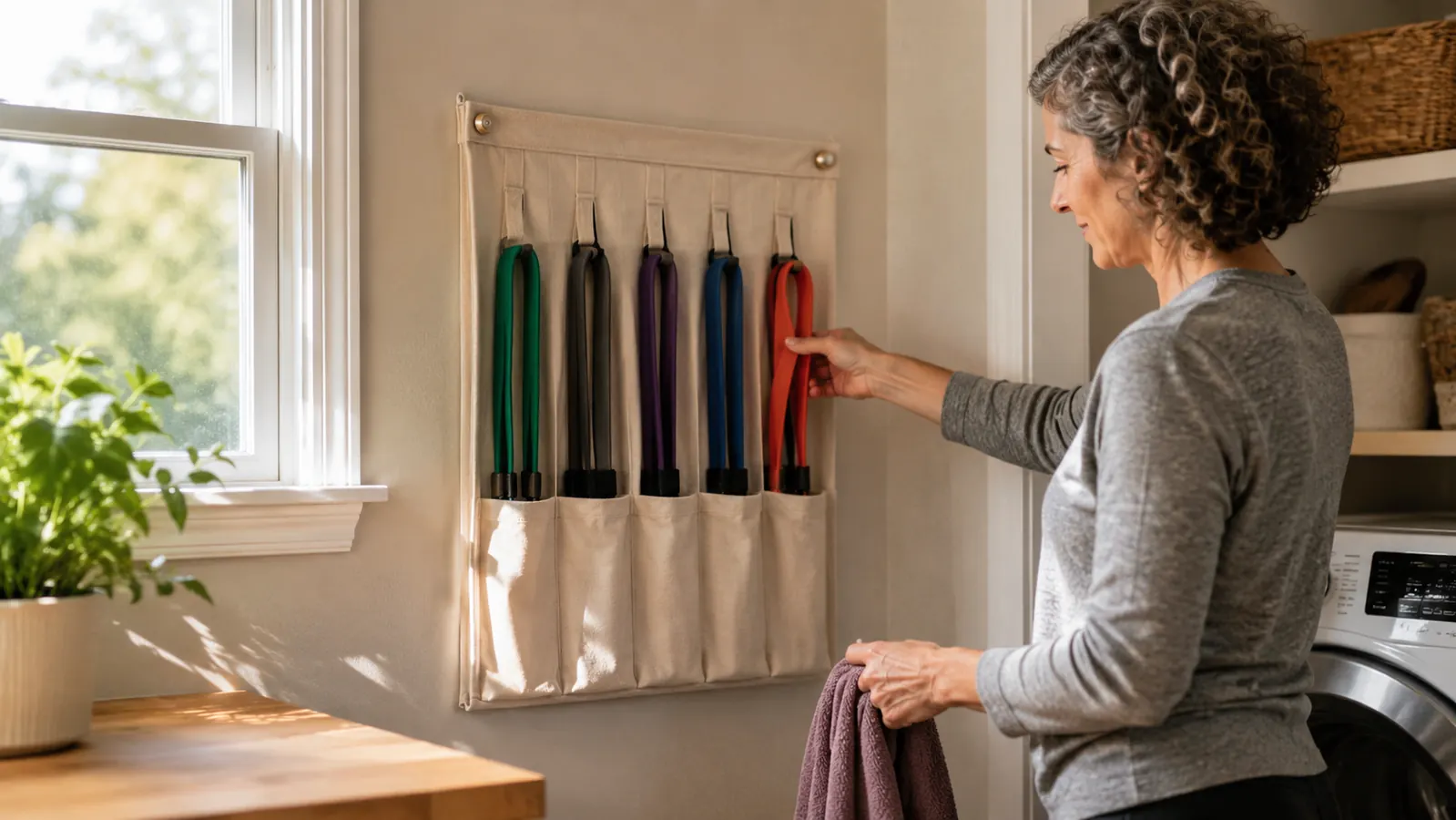
Before the specifics, the context that set my verdict. The bands live in a cloth pouch that hangs from a hook by my laundry room door, and on a normal week they come out three mornings for warm ups and once for a full session. A full band session for me is about 35 minutes: banded rows, banded pushdowns, banded squats and a shoulder circuit. That is not a heavy workout. It is a keeps the muscles awake workout, and it is precisely the kind of workout these bands were built for.
The set ships with five bands, two handles, a door anchor and an ankle strap. You click a band into a plastic jaw on each handle and work. Setup takes under a minute. That convenience is the real product here, more than any single band, and I would not want to lose it. I also took the set two nights to my sister's place in Tucson and used it on my back patio on the cool mornings when the garage felt like an oven. That portability is where these earn their keep.
The full session has settled into a shape I can describe because it is the same every week. Banded rows off the door anchor, ten to twelve reps, three sets, with the middle band. Banded pushdowns for the triceps, which the heaviest band feels best for. A light band for banded squats to warm the hips before I ever touch the bar, and a shoulder circuit where I stand on the middle of the band and raise both arms out to the side. That last one is the exercise I did not expect to keep. It gives my shoulders real work with none of the spinal loading, and on stiff mornings it is the difference between training and sitting on the couch.
Do the Bands Actually Stretch Out? The Question That Brought You Here
Short answer: yes, and it is gradual enough that you will not notice until you notice. The light bands lose their snap first. Around month five I started to catch my banded rows feeling easier than they should, and not because I got stronger. The lightest band had gone slack. It still stretched and returned, but the firm part of the pull arrived later in the movement now.
The heavier bands hold up far better. The middle and heaviest bands still feel close to new, which is the practical answer for most people because those are the bands you actually resist against. The light bands are warm up tools anyway. So the honest version of the headline question is this: the bands you rely on for real resistance will last, and the ones you barely use will drift. That is a fair trade for a set at this price.
One small habit changed things for the better. I hang the bands flat now instead of leaving them tangled in the pouch. These bands degrade fastest when they sit doubled over in a knot for weeks. Stored hanging on their own loops, they keep tension noticeably longer. The organizer that comes with the set encourages the worst storage, so I would ignore it and hang them.
There is a ten second test for slack that has saved me from second guessing. Hold a band at both ends, stretch it slowly to about body height, then ease it back. A good band snaps back with a firm pull right away. A tired band returns slowly and feels rubbery under the fingers, like gum that has lost its fight. I run that test on the two heaviest bands about once a month and they still pass. The light band would not, and I have stopped using it for anything except a stretch marker. That is my honest summary of durability: the bands you actually fight last, the ones you barely use do not, and you can feel exactly which is which.
The Handle Problem Nobody Mentions
Here is the flaw I almost never see discussed in the review section. The clips that lock a band onto a handle use a plastic cam, and that cam can work loose under the heaviest band. It happened to me once on a one arm banded row, and the handle snapped free and came at my face. I was lucky it missed. After that I started pushing the cam home hard before every set, and it has never happened again.
This is not a defect in a bad batch, or at least I do not think so. It is a maintenance habit. Check the grip before you work, keep the heaviest band on the ends you can see, and stop using a handle the moment the locking teeth start to look smooth. None of that appears in the product photos, and none of it is in the marketing copy. It is the difference between a tool that feels solid and one you have to keep an eye on.
The handles have a ridged rubber grip that I like more than I expected, with one warning. On a warm Mesa afternoon my palms sweat, the grip goes slick, and a banded row at full tension wants to twist the handle in my hand. A cheap pair of grip gloves I already had fixes that completely. The other thing nobody mentions is the plastic jaw that holds the band. It is open at the front, so a band can slide partway out if you clip it carelessly instead of seating it all the way to the far edge. Seat it flush, check the teeth, and the whole rig feels tight. Ignore the fit and you will chase problems that were never the band's fault.
The Door Anchor Is Picky About Your Door
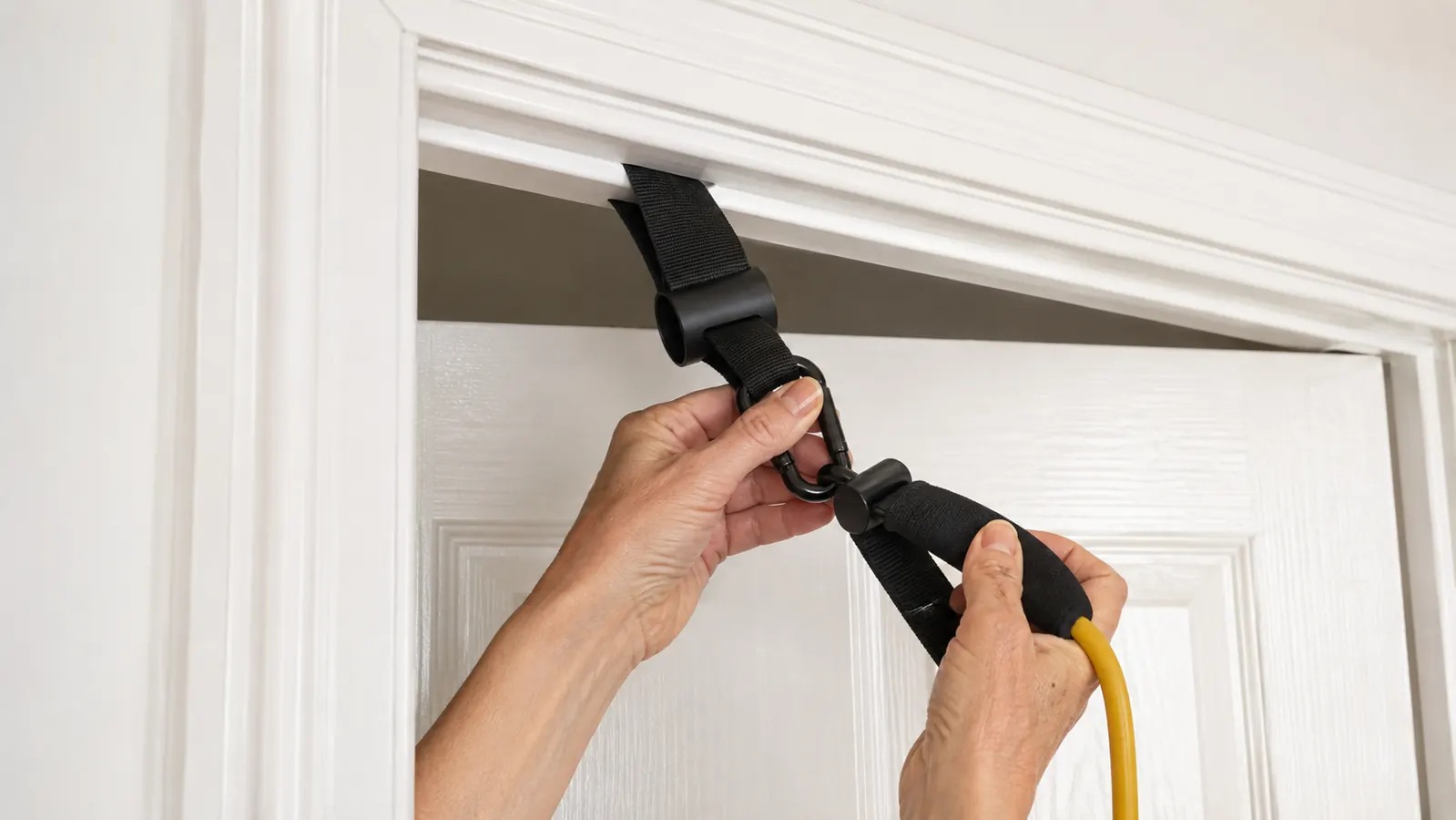
The door anchor is a webbing loop with a rubber block that wedges between the door and the frame. On my garage door and my bedroom door it seated fine. On the jamb of my patio slider, it would not hold at all. The block needs a typical door gap to bite into, and some frames are too tight for it to seat. If yours does not feel rock solid, do not use it. A shoulder row against a loose anchor is how you smash a knuckle.
There is a workaround most people find on their own: shut the loop into the top corner of the door and pull it closed. It crimps the band edge and is not great for the band, but it works in a pinch. The bigger quirk is height. The anchor sits at door top, which is fine for rows and lat work and wrong for most presses, because you end up pulling down at an angle. I do presses with the band anchored low instead, around a porch post, which keeps the line of pull where it belongs.
The trip to Tucson taught me the frame matters as much as the door. My sister's guest room had a bigger gap than mine, so the anchor that seats firmly at home sat loose there, and I had to wedge a folded washcloth behind the rubber block to take up the slack. It worked, but it told me something: this anchor assumes a standard door, and standard is a range, not a fixed size. If you travel with the set, expect to reinvent the seating on every unfamiliar frame rather than plug it in and work. For someone who only ever uses it at home, that quirk never surfaces.

Five Levels Sounds Even. It Is Not.
WHATAFIT calls this a 5 level set, which reads like five neat increments of difficulty. It is not that. The gap between the two lightest bands is small, and the jump from the middle band to the heaviest is enormous. For many of us over fifty, that top band is simply too heavy to start with. So a beginner reads five levels and ends up with a set where two of the five are nearly unusable for the first several months.
That is not a reason to skip the set. It is a reason to start with the middle bands in your head first, use them until they feel easy, and grow into the heavy one. The marketing overstates the progression, and the review section rarely says so. You will feel it the first time you click the heaviest band and realize you cannot finish a set. Accounts for more returns and one star reviews than any other single issue, I suspect.
A clearer way to think about the levels is by what each one is for, because the colors carry no number and the listing never explains them. The two lightest bands are warm up and mobility tools and not much else. The middle band is where rows and endurance work live. And the heaviest band is a genuine strength tool that will humble anyone starting out. I clipped it in on day two and could not finish a set of pushdowns. Six months later it is the band I reach for first. That progression is real, and it is also slower than the five level label suggests. Plan in months, not days, before the top band becomes your everyday resistance.
What I Liked
- Joint friendly progressive resistance you pick up without loading plates
- Genuinely portable and flat enough to hang behind a door
- The heavy bands keep tension well over months
- Under a minute to set up and easy to wipe clean
- Price is hard to argue with for the range you get
Where It Falls Short
- The light bands go noticeably slack by about month five
- The handle cam can slip under the heaviest load
- The door anchor only fits some doors and frames
- Level jumps are wide, and the top band is too much for beginners
- The included pouch encourages the storage that wears bands out fastest
Around month five my banded rows started feeling easier, and not because I got stronger. The light band had gone slack. That is the honest end of these bands, and it took nine months to arrive.
Who This Is For
Buy these if you want something to keep the routine going on heavy rest days, while traveling, or when the joints say the bar is too much. They shine as a warm up set, a hotel set and a first strength tool for someone easing back after time off or an injury. If you are in your fifties or sixties and the goal is to keep moving without loading a spine that has had enough, the WHATAFIT set is a sensible, cheap place to start.
The reader I picture when I recommend these is someone my age who owns a bar or a set of dumbbells but skips the warm up because it feels like a waste of time. A band set makes that warm up cheap and obvious, and it actually gets done because it takes under a minute to set up. If that is you, the WHATAFIT set is one of the simplest ways to add the part of training that never gets its credit.
Who Should Skip It
Do not buy these expecting to replace a set of dumbbells. They cannot give you the same feel for heavy progressive overload, and the wide jumps between levels make them awkward for that job. Skip them too if your only door frame will not seat an anchor, because you will be fighting the setup more than the workout. And if you are someone who wants a tool you never have to think about, the cam check and band care will quietly annoy you. These reward a little attention.
And if you have already decided bands are not for you, I am not here to talk you out of it. A person who hates fuss, who will not check a grip or hang a band flat, should buy a different tool and put the money where they will actually reach for it. Bands reward a little attention, and pretending otherwise is exactly the kind of pitch these reviews are supposed to cut through. If that is you, skip them and spend on what you will use.
I still use mine three mornings a week, so that is the honest recommendation of record.
They are not perfect, but for the price and the portability they do exactly what I ask of them. Check today's price and decide for yourself.
Amazon See Today's Price on Amazon →